
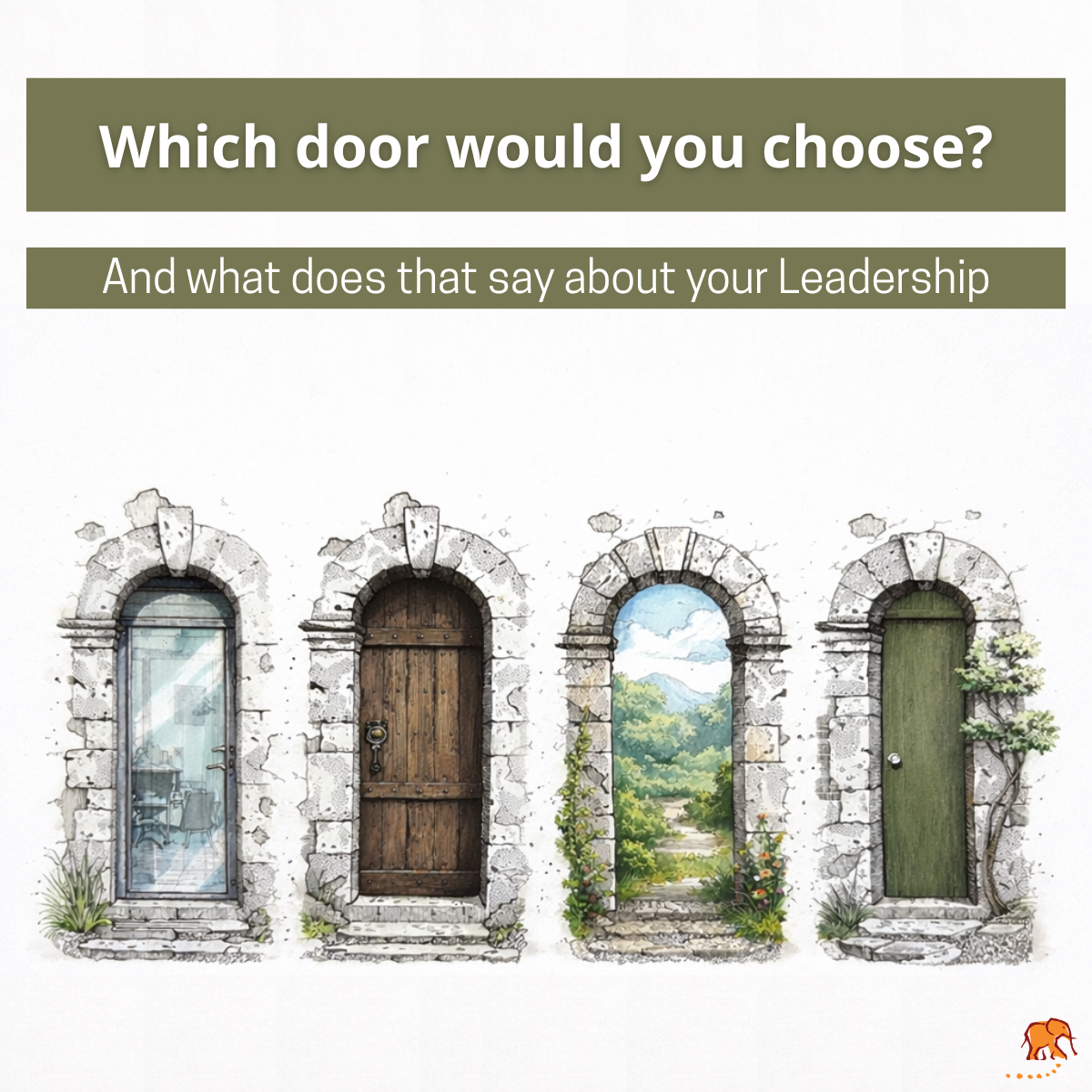

You are standing in front of four doors. Your team is behind you, looking for a way forward. One door offers the transparency of glass; another, the weight of tradition. One is a wide-open archway of possibility, and the last is a narrow path of pure discipline. The door you choose doesn’t just define the next hour—it defines the culture of your next chapter.
Most leaders have a default door they prefer to walk through. But in a world of constant change, a fixed style isn’t a strength—it’s a ceiling. To be an exceptional leader, you must move beyond your favourite door and develop the agility to open the one the business requires right now.
The Four Mindsets of Change
Leadership excellence is found in mastering the key to these four distinct paths:
- Door 1: The Glass Door (Transparency & Accountability). You lead with clarity, ensuring the why is visible to everyone so they can move with ownership.
- Door 2: The Heavy Wooden Door (Tradition & Structure). You provide the grit and proven frameworks that keep a team grounded when the environment feels turbulent.
- Door 3: The Open Archway (Flexibility & Creativity). You remove the barriers, inviting organic growth and innovation without the weight of how we’ve always done it.
- Door 4: The Narrow Doorway (Focus & Discipline). You provide the precision needed to cut through the noise and achieve specific, high-impact goals.
The Three Pillars of the Shift
Knowing when to change direction requires more than just gut instinct; it requires three dimensions of strategic insight:
1. Self-Insight: Identifying Your Default
We all have a comfort zone. You might instinctively reach for the Heavy Wood of structure when stressed, even if your team is actually feeling constrained and needs the Open Archway of creativity. Self-insight is the ability to recognise your bias so you can lead the situation, rather than letting your habits lead you.
2. Insight of Others: Reading the Room
The door you choose must meet your team where they are. If your people feel overwhelmed and scattered, opening the Archway of Creativity might destabilise them further. In that moment, an exceptional leader provides the Narrow Door of Focus to restore a sense of safety and progress.
3. Contextual Awareness: The Business Head
Strategy isn’t personal; it’s contextual. There are seasons for radical Transparency and seasons for rigid Structure. Contextual awareness is the objective lens that asks: “What does the business strategy require of me in this moment?”
Precision Over Habit
Leading through change is an exercise in intentionality. It requires the courage to step away from the door that makes you feel safe and walk through the one that makes the team successful.
To bridge the gap between heart and head in our own leadership, remember:
- Agility over Habit: Your style is a toolkit, not an identity. Learn to switch between transparency, structure, creativity, and discipline.
- The Power of Insight: Catch your own biases (Self-Insight), read what your team is actually feeling (Insight of Others), and prioritise what the business requires (Contextual Awareness).
- The Intentional Shift: The most effective door is rarely the most comfortable one.
Mastering the movement between these four doors is the difference between simply managing a team and leading them. Because true leadership isn’t about where you stand, it’s about where you are willing to go to bring others with you and drive business success.
Find out more by getting in touch with us today – meetus@jp.co.za